
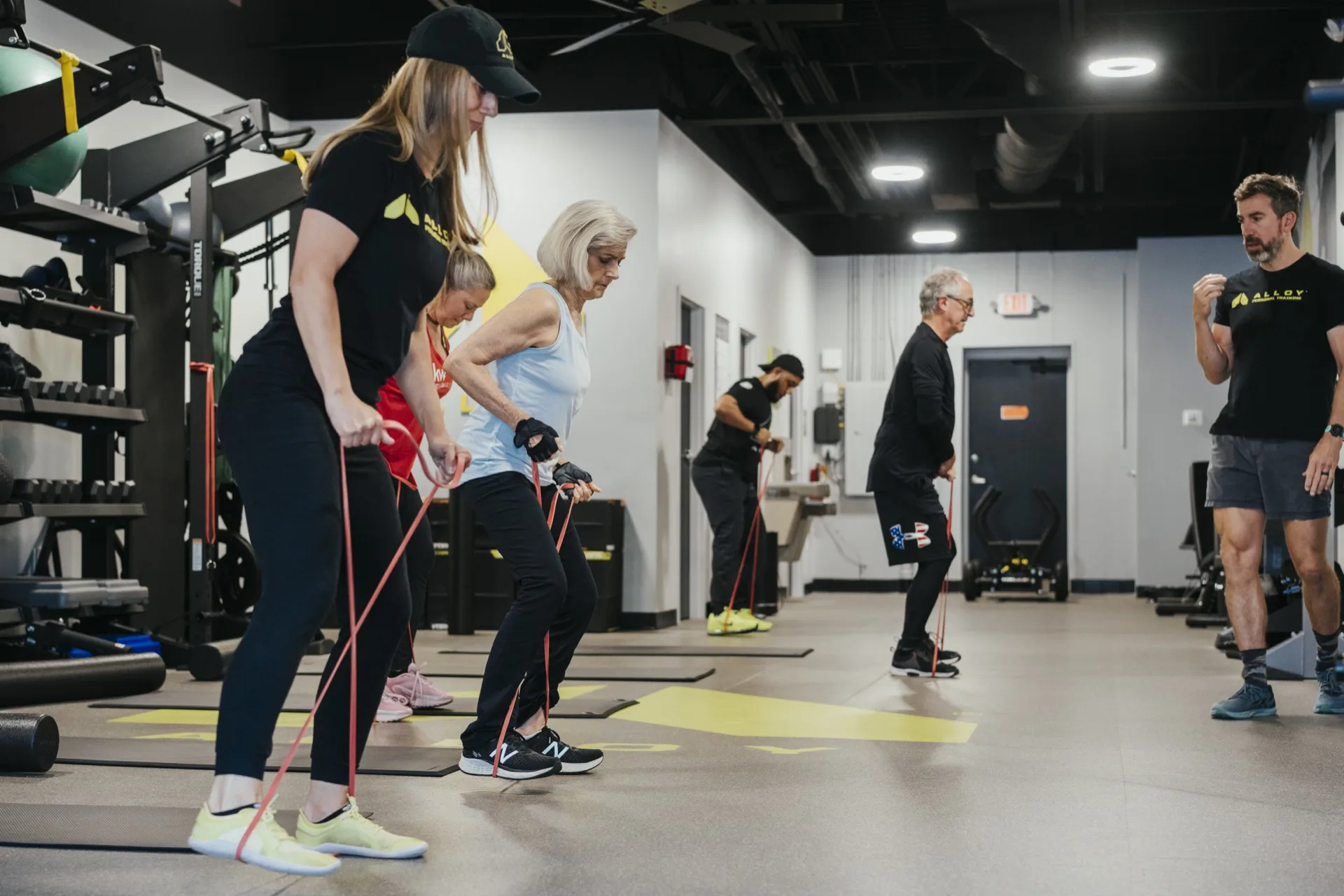
Small group personal training is coached strength training for a handful of people at once, where each person follows a program written for them instead of a class routine. NASM describes it as sessions for two to ten clients that combine the personalization of one-on-one coaching with the energy of a group. The coach runs the session rather than working out alongside it, adjusting weights and exercises person by person. At our Pinecrest studio, sessions are capped at six clients per coach, run about 55 minutes, and start with an assessment of your history and goals.
- Small group personal training puts a few people with one coach, each on their own program.
- Ratio matters: untrained young men coached one per five gained more bench press strength than those coached one per 25.
- Two strength sessions a week meets the federal muscle-strengthening guideline.
- In a 2025 trial, people coached in person completed 88.2% of sessions; those given a written program completed 52.2%.
- Individualized training starts with an assessment of how you move, your history, and your goals.
What small group personal training actually is
The defining feature is individual attention inside a small group. ACE notes that small-group training is also known as semiprivate training. Its guidance calls four or five people ideal with one coach and sets eight as the maximum with one trainer. ACE is also candid about the trade-off: compared with one-on-one sessions, clients "do lose some of the customization and the full focus of the trainer."
A low cap keeps that trade-off small. Ours is six clients per coach, inside ACE's eight-person maximum and close to the one-to-five ratio tested in a trial described below. Our small group personal training in Pinecrest is coach-led from warm-up to the last set, and every workout is built around each person's abilities, limitations, and goals.
Here's how the common formats compare:
| Format | Group size | Who writes the program | Who picks your weights and exercise options |
|---|---|---|---|
| One-on-one training | One client | Your trainer, for you | Your trainer |
| Small group personal training (often called semi-private) | A few per coach, roughly 2 to 10 | The coach, for each person | The coach, person by person |
| Group fitness class | The whole room | The instructor, one routine for everyone | You, usually |
| Boot camp or HIIT class | The whole group | The coach, one workout for the group | You, at the group's pace |
| Training on your own | Just you | You, an app, or a printout | You |
Within a mile of our studio on US-1 you can find nearly every kind of gym: reformer Pilates, yoga, EMS, HIIT classes, a women-only club, boxing, and big-box floors. Each works for someone. Small group personal training is for adults who want a coach doing the planning, not a crowded gym floor or a chaotic boot camp.
Does having a coach in the room change results?
In the trials that tested it, yes, and the size of the group mattered too. The closest study to most readers here is a 2014 trial by Storer and colleagues. It followed 34 men aged 30 to 44, all members of one Southern California health club, for 12 weeks of training three days a week. Half were randomly assigned a trainer; the other half trained on their own.
The trainer-led group gained about 1.3 kg of lean body mass, while the self-directed group showed no change. Chest press strength rose 42% with a trainer versus 19% without. Leg press gains were closer, 38% versus 25%, and not statistically different.
A second trial tested the coach-to-client ratio directly. Gentil and Bottaro (2010) put 124 untrained young men on identical 11-week programs and randomized them to one coach per five people or one per 25. Bench press strength rose 15.9% at one per five versus 10.22% at one per 25, and knee extensor torque, a measure of thigh strength, rose 11.8% only in the smaller-ratio group.
Attendance did not differ between the groups, and more of the one-per-five trainees worked at maximal intensity. That points to what happened inside the sessions.
Neither study included women, and the older group topped out at 44, so read them as direction, not a promise. The direction is consistent, though, and it's why the cap matters more than the label on the door.
How often should you do small group training?
Two sessions a week is a sound target for most adults starting out, and it meets the federal minimum for strength work. The Physical Activity Guidelines for Americans call for muscle-strengthening activities of moderate or greater intensity, involving all major muscle groups, on two or more days a week. They also recommend 150 to 300 minutes a week of moderate aerobic activity.
The National Strength and Conditioning Association's 2019 position statement, built on trials in adults 50 and older, recommends resistance training two to three times per week. A third day is optional, though. A 2018 review of 22 studies found that when total weekly training volume was matched, training more often did not produce significantly greater strength gains. In middle-aged and older adults, the effect of frequency was not significant either.
Extra sessions seem to help mainly by adding more total work, so two well-run sessions plus walking on other days is a solid plan. The track at Evelyn Greer Park, just down SW 124th Street from the studio, makes the walking part easy, and the Old Cutler Trail is a good change of scene.
What individualized training looks like in a group
Individualized training in a group means six people can share a room and a coach without sharing a program. The NSCA statement above says programs "should follow the principles of individualization, periodization, and progression." In plain terms: built for you, planned in phases, and harder only when you're ready.
In our sessions, that looks like this:
- An assessment before session one. A coach sees how you move and hears your history before writing anything, so your program starts from facts instead of guesses. That's the job of the Personal Fitness Assessment.
- Your own loads and options. Two people at the same station might do the same movement at different weights, or one might squat to a box until the full movement feels right.
- Mobility work for stiff joints. Tight hips and stiff shoulders get targeted movement prep and corrective exercises, and old injuries are planned around. Our functional mobility and joint-health work is built into every plan.
- Progress tracked on purpose. Programming is structured, so loads and exercises change on a plan. Every 30 days, an accountability session updates your InBody body composition scan, reviews progress, and refines your goals.
Why a small group makes it easier to keep showing up
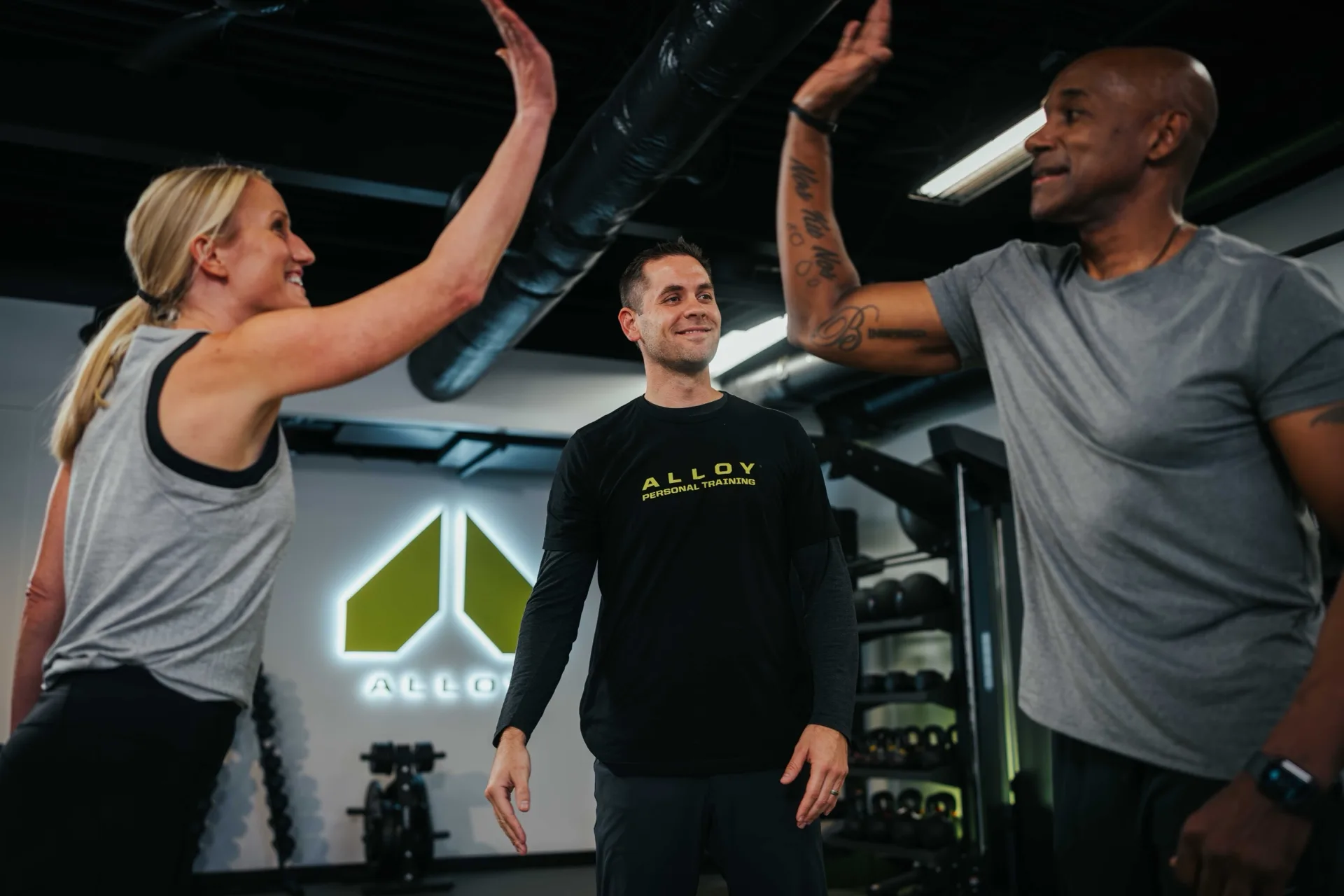
A small group gives you a standing appointment and a coach who expects you, and both make it easier to show up. In a 2025 trial, 79 adults who already strength trained (48% women, average age about 31) were randomized to three ways of training, three times a week for 10 weeks.
Those with a coach in the room completed 88.2% of their sessions. An app-guided group completed 81.2%, and people handed a written program completed 52.2%. The coached group's one-rep squat max rose 26.6 kg, versus 19.2 kg and 19.4 kg in the other two, and only the coached group gained fat-free mass, about 1.4 kg.
The group part deserves an honest caveat. A 2026 review of 71 studies, more than half of them focused on adults 50 and over, found group and individual programs produced similar physical activity levels overall, with a small edge for groups on physical function. So the format alone does no magic. What seems to help is cohesion: a 2006 meta-analysis of 44 studies found people stuck with exercise best in groups deliberately built for cohesion, and that an ordinary drop-in class was no better than exercising at home with some contact. What we build around is the combination: a coach who writes your program, and a small, steady group where the coach knows every client by name.
Miami-Dade heat and humidity add a practical reason: through the May-to-October wet season, outdoor plans get rained out, while a fixed indoor time holds. Long-term results come from that kind of consistency.
How to compare small group training near you
Search for "small group training near me" and the results mix every format in the table above. Small group sessions usually cost less per person than one-on-one training because the coach's time is shared. Our guide to what personal training costs in Miami, one-on-one versus small group covers the market numbers.
Ask any studio four questions before you sign up:
- What is the cap per coach, and does it hold every session?
- Who writes my program, and how does it change as I progress?
- Is there an assessment before my first workout? Our guide explains what a good fitness assessment covers.
- How is progress tracked, and how often do we review it together?
With that kind of coaching in place, most people notice improvements in energy, strength, and confidence within the first few weeks. Body-composition changes typically show over 8 to 12 weeks.
Who small group personal training fits in Pinecrest
Small group personal training fits adults who want coaching and a written plan rather than a class or an open gym floor. Our programs are designed primarily for adults 40 and over, and all ages are welcome. That matches the village well: Census Bureau figures from the 2020 to 2024 American Community Survey show roughly three in four Pinecrest adults are 40 or older.
It works for people starting out, starting over, or coming back after time away. It also supports what active people here already do, whether that is pickleball at Dante Fascell Park, a round at Palmetto Golf Course, or a paddle at Matheson Hammock Park. Joint stiffness, old injuries, and chronic tightness are common, and the assessment is where we plan around them.
If you have pain, a recent injury or surgery, or a diagnosis, talk with your physician or physical therapist before you start. We're glad to coordinate with them. New or worsening symptoms, such as chest pain or joint pain that doesn't settle, need a clinician's attention first.
Start with how your body moves
At Alloy Personal Training Pinecrest, the free Personal Fitness Assessment answers the question this guide can't: will small group training fit your body and history? A coach looks at how you move, talks through your health history and goals, measures your baseline, runs your first InBody scan, and maps out your roadmap and the membership that fits. There's no pressure, and you'll get straightforward pricing before you decide anything. Book your free Personal Fitness Assessment.
Opening October 2026 at 8285 SW 124th Street. Our first 75 founding members get first pick of session times, priority onboarding, and our Founder's Rate. See founding membership.
This article is general fitness information, not medical advice. Talk with your physician before starting a new exercise program, especially if you have a diagnosis, a recent injury or surgery, or activity restrictions.