
A fitness assessment is a structured session, usually under an hour, in which a coach or other fitness professional screens your health history and measures where you are today. The baseline typically covers body composition, cardiorespiratory fitness, muscular strength and endurance, and flexibility or movement quality, and those numbers shape your plan. It is not a medical exam, and it does not diagnose anything. Its real value shows up a few weeks later, when you measure again and compare.
- A fitness assessment pairs a short health screen with baseline tests of body composition, cardio fitness, strength and flexibility or movement.
- It is not a medical exam. Symptoms such as chest discomfort, dizziness or unusual breathlessness mean talking with your physician first.
- In one Norwegian study, field-test scores held steady until about 50, then declined, so a baseline in your 40s or 50s is worth having.
- A lab gives you a more precise single number; a coached assessment gives you a plan and a trend you can repeat.
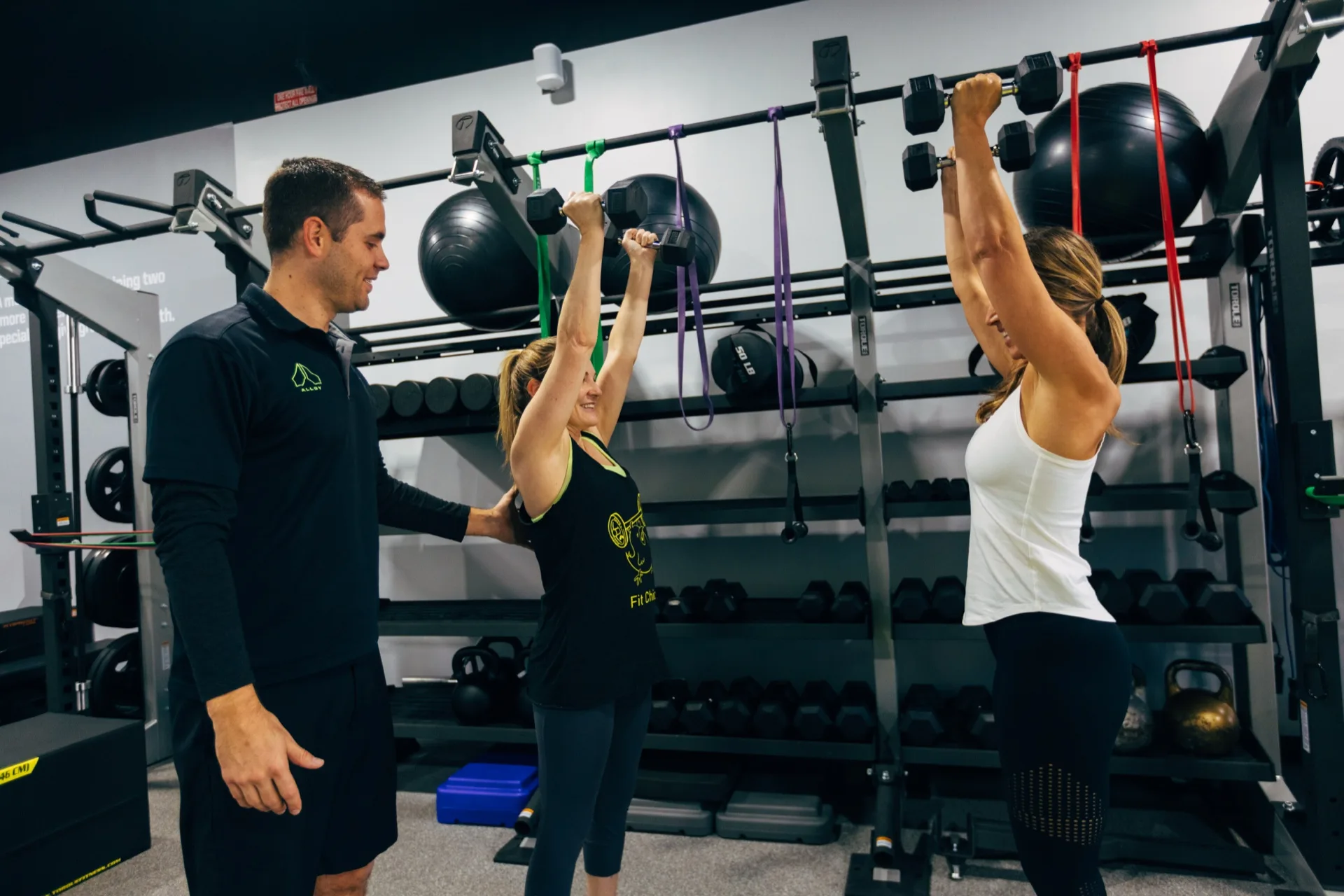
What a fitness assessment is, and what it isn't
ACSM's assessment manual organizes testing around four components: body composition, cardiorespiratory fitness, muscular fitness and flexibility. Many coaches add a fifth, movement quality, because how you squat, lunge or reach overhead shapes exercise choices as much as any score.
A good assessment flags anything that needs a physician's input, records a baseline to compare against, and turns a loose goal like "get stronger" into numbers you can track.
The limits matter just as much. A coach can notice that your right hip moves differently from your left, but only a clinician can tell you why. When something needs a clinical answer, the right step is a referral, and we're glad to coordinate with your physician or physical therapist.
What is included in a fitness assessment?
Counting the health screen, most fitness assessments include five parts: a health screen, a body-composition reading, a cardio test, strength and endurance tests, and a flexibility or movement check. The table shows common examples; a coach picks what suits you.
| Part | What it tells your coach | Common examples |
|---|---|---|
| Health screen | Whether anything needs a physician's input first, plus your activity level, medications and old injuries | A questionnaire such as the PAR-Q+, followed by a conversation |
| Body composition | Muscle, body fat and fluid balance | A bioelectrical impedance scan such as InBody |
| Cardiorespiratory fitness | How your heart and lungs handle steady effort | A timed walk, a step test, heart-rate readings |
| Muscular strength and endurance | Leg, grip and upper-body strength | A 30-second chair stand, a grip test, a modified push-up |
| Flexibility and movement | Range of motion and how your joints work together | A sit-and-reach, a bodyweight squat, a lunge, an overhead reach |
Not every assessment runs every test. Someone with a cranky shoulder doesn't need a push-up test on day one. From the coaching side, the history conversation often shapes the plan more than any single score. An old ankle sprain or a knee that dislikes stairs changes exercise choices before the first rep.
At Alloy Personal Training Pinecrest, the Personal Fitness Assessment is built on the same idea. It covers how your body moves, your health history and goals, your current fitness baseline and your first InBody scan, and all of it feeds a personalized roadmap.
Step one is a health screen, not a workout
Before any testing, a good coach asks questions.
ACSM's 2015 screening update boils the screen down to three questions. How active are you now? Do you have symptoms, or a known heart, metabolic or kidney condition? And how hard do you plan to train?
Many coaches use the PAR-Q+ questionnaire for this. In its 2011 validation study, it referred 0.8% of participants for medical clearance, compared with 15% under the older PAR-Q.
Some answers mean you should see a physician before any testing. The signs and symptoms listed by ACE in its summary of the updated screening guidelines include:
- Pain or discomfort in the chest, neck, jaw or arms
- Shortness of breath at rest or with mild exertion, or trouble breathing when lying flat
- Dizziness, fainting, heart palpitations or a known heart murmur
- Ankle swelling, leg pain that comes on with walking, or unusual fatigue during usual activities
If any of those apply, talk with your physician before you start, and see a clinician promptly for anything new or worsening. Federal activity guidelines also say people with chronic conditions or symptoms should be under the care of a health care provider. They can ask that provider which types and amounts of activity suit them, and an assessment is where that guidance turns into specific exercise choices.
What do fitness assessment numbers mean after 40?
After 40, the most useful comparison is you against your own next test, with age-group numbers a close second.
The reason to measure now is timing. A 2014 Norwegian reference study of 370 adults aged 18 to 90 used five field tests: a six-minute walk, a stair test, a 30-second sit-to-stand, handgrip strength and a fingertip-to-floor reach. Performance held steady until about age 50, then declined with increasing age. A baseline taken in your 40s or 50s gives you a real "before" picture.
Two reference sets are worth knowing:
| Test | Group | Reference figure | Source |
|---|---|---|---|
| Grip strength, right hand | Men in their 40s, 50s and 60s | Averages of 47 kg, 45 kg and 40 kg | Australian population study of 1,366 men and 1,312 women (2011) |
| Grip strength, right hand | Women in their 40s, 50s and 60s | Averages of 29 kg, 28 kg and 24 kg | Same study |
| 30-second chair stand | Men aged 60 to 64 | Fewer than 14 stands is below average | CDC's STEADI toolkit |
| 30-second chair stand | Women aged 60 to 64 | Fewer than 12 stands is below average | Same toolkit |
The spread around each grip average is wide, so one reading says little on its own. CDC's version of the chair stand uses a 17-inch straight-back chair with arms crossed on the chest, and counts full stands in 30 seconds.
Read these as reference points and leave health questions about any number to your physician. A score below the line tells a coach where to begin. Our strength training for adults over 40 is built to scale from wherever your baseline lands.
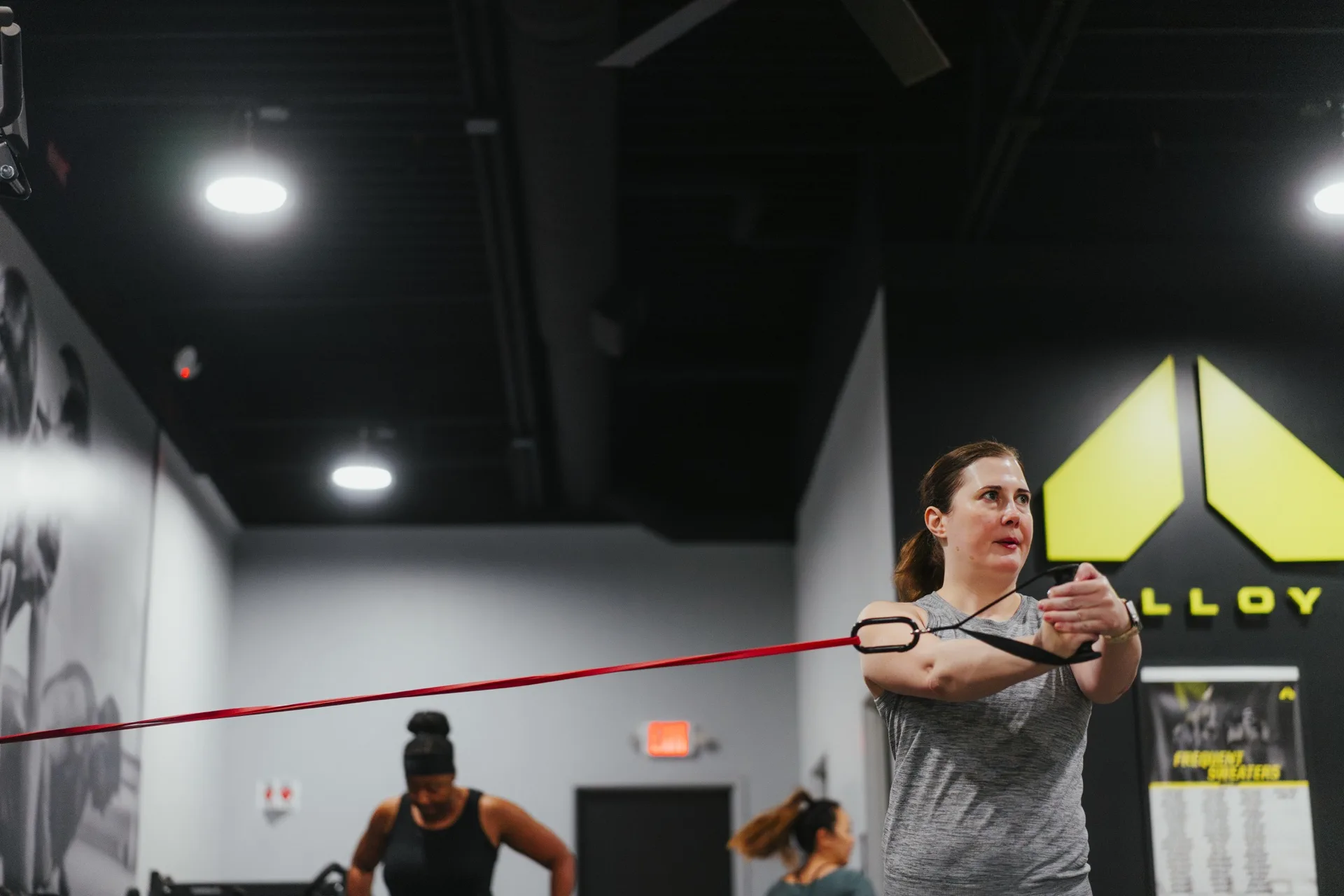
Coach assessment or lab test: which do you need?
For most people starting a training program, a coached assessment is the more useful choice. A lab test makes sense when you want one precise measurement, such as a measured VO2 max.
Search "fitness assessment near me" in Miami-Dade and many of the results are clinical. University exercise labs and standalone testing providers list VO2 max tests at roughly $149 to $150 for the public (September 2026 prices). Many also list body-composition scans such as DXA, plus resting metabolic rate testing, an estimate of resting calorie needs. Prices for those vary by provider.
A lab gives a more precise single reading. What it doesn't hand you is a plan, or the same test in the same room a month later.
Bioelectrical impedance analysis (BIA), the method behind the InBody, shows the trade-off. In a 2025 comparison of 1,000 active-duty US Marines, mean age 28, an InBody 770 read body fat lower than DXA on average. The gap was 4.2 percentage points in men and 2.8 in women. The readings were closely correlated, and the researchers concluded that "BIA does track changes in body composition."
That was a young, fit group, so the exact gap may not match yours. Either way, absolute numbers differ by device, so track the change over time on the same device, under the same conditions.
Our InBody scan reports skeletal muscle mass, body fat percentage, visceral fat level, total body water and a segmental breakdown. For what the body-fat number means, see our guide to healthy body fat percentage after 40.
How to prepare for a fitness assessment test
Preparation is mostly about making your body-composition reading repeatable. InBody's testing guidelines ask you to:
- Wait 2 to 3 hours after eating
- Test before you exercise, not after
- Empty your bladder first
- Skip the shower or sauna for an hour beforehand
- Stand barefoot and remove any metal
- Book repeat scans at the same time of day
Beyond the scan, wear clothes you can move in and bring a list of your medications, past surgeries and old injuries. Bring your goals too, even rough ones. "I want to get up off the floor without grabbing the couch" gives a coach plenty to work with. So does "I want to walk 18 holes at Palmetto Golf Course without my back complaining" or "I want to keep up in Sunday pickleball at Dante Fascell Park."
Conditions matter for the fitness tests as well. A walk test on a sticky August afternoon in the wet season won't compare cleanly with one on a January morning. That's why baselines belong indoors. Save the outdoor miles for the walking track at Evelyn Greer Park next door or a ride down Old Cutler Road, between sessions.
What happens next: your roadmap and first re-test
A fitness assessment should end with a plan and a date to measure again. For anyone who has been inactive, the same federal guidelines put the pace plainly: "start low and go slow."
Re-testing is where an assessment pays off. In NASM's guidance on heart-rate training, reassessments can happen every 4 to 6 weeks in most cases, or whenever there's a clear change in a client's performance, breathing or resting heart rate.
We re-measure every 30 days. Each month includes an accountability session with an updated InBody scan, a progress review and refined goals, so the roadmap adjusts to what the numbers show. Between those check-ins, you train in coach-led small group sessions of about 55 minutes, capped at six clients per coach. Every workout is individualized to your abilities, limitations and goals.
Most people notice improvements in energy, strength and confidence within the first few weeks. Body-composition change typically shows over 8 to 12 weeks, and long-term results come from consistency.
Start with a baseline you can re-measure
Our free Personal Fitness Assessment is the session this article describes. A coach looks at how you move, talks through your health history and goals, measures your baseline and runs your first InBody scan. Then the coach maps out your roadmap and the membership that fits, with no pressure and nothing to pass or fail. Book your free Personal Fitness Assessment and leave with numbers worth re-testing.
Opening October 2026 at 8285 SW 124th Street. Our first 75 founding members get first pick of session times, priority onboarding, and our Founder's Rate. See founding membership.
This article is general fitness information, not medical advice. Talk with your physician before starting a new exercise program, especially if you have a diagnosis, a recent injury or surgery, or activity restrictions.