
Hip mobility exercises for adults over 40 work best as a mix of strength work through a full range of motion and short, regular stretching, not stretching alone. A 2021 meta-analysis of 11 trials found strength training and stretching improved range of motion to a similar degree. The eight moves below cover what a stiff hip usually needs: extension at the front, rotation, and strength on the outside.
- In a US national sample aged 25 to 74, average hip motion differed by only 3 to 5 degrees between the youngest and oldest groups.
- ACSM recommends 10 to 30 second holds for most adults and 30 to 60 seconds for older adults, repeated 2 to 4 times, at least 2 to 3 days a week.
- Before a workout, keep static holds under 60 seconds and follow them with dynamic moves.
- Hip pain that disturbs sleep, keeps getting worse, or hasn't improved after 2 weeks is a reason to see a clinician first.
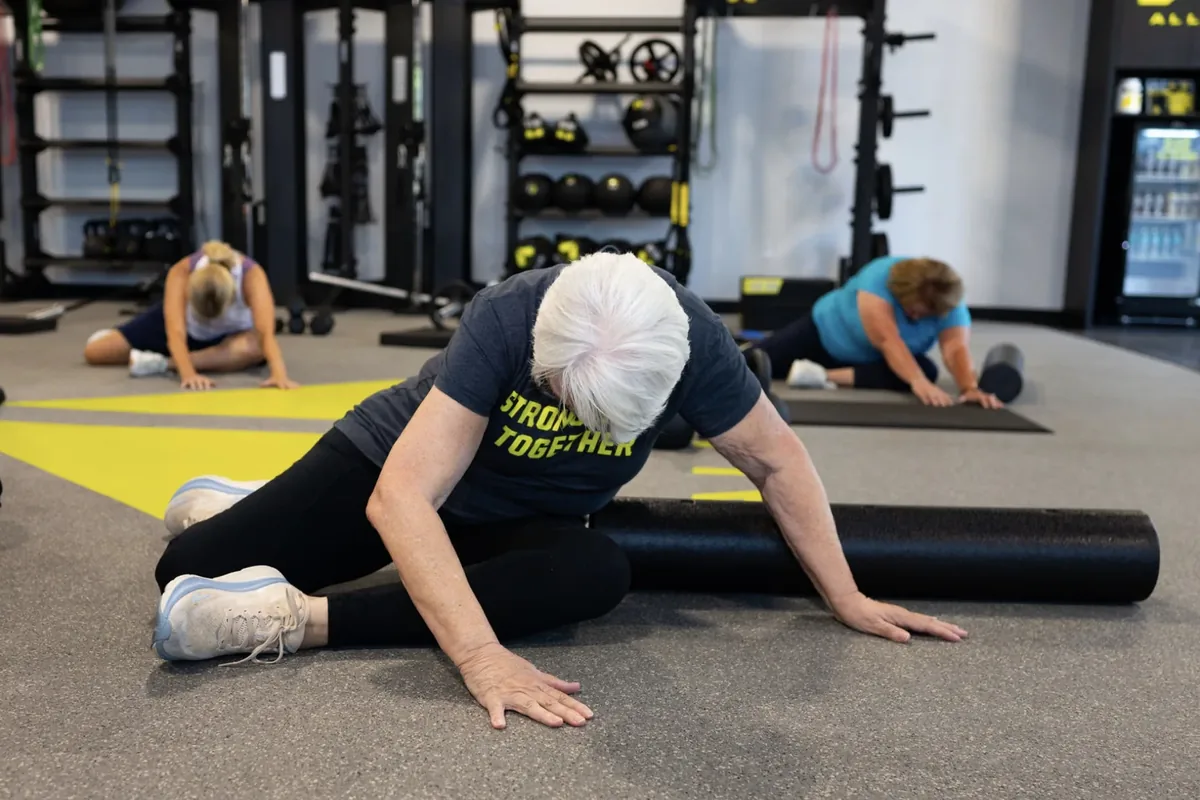
Tight hips over 40: why age is only part of the story
Tight hips over 40 have less to do with age than most people assume. A 1991 analysis of US national survey data analyzed hip and knee motion in 1,683 adults aged 25 to 74. Average hip motion differed by only 3 to 5 degrees between the youngest and oldest groups. The authors concluded that, at least to age 74, "any substantial loss of joint mobility should be viewed as abnormal and not attributable to aging." That matters in Pinecrest, where roughly three in four adults are 40 or older, according to Census Bureau data.
Sitting habits are worth a closer look. In a 2015-2016 national survey of 5,923 US adults, 25.7% reported sitting more than 8 hours a day. The share who sat that long and also got no leisure-time activity rose with age. A commute on US-1 and a full day at a desk add up fast.
That combination is linked to stiffer hips. A 2021 study sorted 98 people by sitting time and activity level. Those who sat more than 7 hours a day and were inactive had 6.1 degrees less passive hip extension than active people who sat under 4 hours.
The study was cross-sectional, so it shows an association, not proof that sitting caused the difference. Still, habits are easier to change than birthdays.
How much hip motion is normal, and which direction goes first?
Most hip range holds up well past 40; hip extension, moving your thigh behind you, is the direction most likely to fade. In the same national sample, hip extension was the only motion measured where the difference between the youngest and oldest groups amounted to more than 20% of its arc.
Walking data point the same way. A 2001 gait-lab study measured peak hip extension during comfortable walking at 20.4 degrees in 30 healthy young adults and 14.3 degrees in 23 healthy older adults. When older participants walked fast, their peak hip extension did not significantly improve.
Hip extension is the motion at the back of every stride and at the top of a glute bridge. That's why the list below leans on moves that open the front of the hip and strengthen the glutes.
Rotation is worth keeping too. A round at Palmetto Golf Course asks for hip internal rotation on both the backswing and the follow-through, and when the hips can't supply it, the lower back usually ends up doing the turning.
Should you stretch tight hips or strengthen them?
Do both, and count strength work through a full range of motion as mobility work. The 2021 meta-analysis cited above covered 452 participants across 11 studies, from adolescents to a group averaging about 82, and found no difference in range-of-motion gains between strength training and stretching.
Hip strength also shows up in how people walk. In a 2023 study of 69 healthy adults averaging 77 years, stronger hip extensors went with faster walking in both men and women. It's a correlation, not cause and effect, but it's a good reason to train the glutes as well as stretch.
Our coaches build hip work around both. Functional mobility and joint-health work means targeted movement prep and corrective exercises built into each client's plan, paired with strength training designed for adults over 40 that loads the hips through their full range. If lifting is new to you, our guide to starting strength training after 40 covers how to begin.
The 8 hip mobility exercises worth doing
Start with the easier version if the full move feels forced, and progress once it feels controlled.
| Move | How to do it | Easier version |
|---|---|---|
| 1. 90/90 hip stretch and switches | Sit with your front and back knees both bent to 90 degrees, shoulders square, and let both hips sink toward the floor. Hold 30 seconds per side for 3 sets, or slowly rotate both knees to the other side for switches. | Stay static, hands on the floor behind you, or sit on a folded towel. |
| 2. Half-kneeling hip flexor stretch | Kneel with the back knee under your hip and the front hip and knee at 90 degrees. Brace your core to keep your pelvis level, squeeze the glute on the kneeling side, and shift forward until you feel a stretch at the front of that hip. | Put a pillow under the kneeling knee. |
| 3. Glute bridge | Lie on your back, knees bent, feet flat. Squeeze your glutes to press your hips up without arching your lower back. Progress to one leg. | Use a smaller range with a 2-second pause at the top. |
| 4. Goblet squat hold | Feet about shoulder-width, a dumbbell held vertically at your chest, elbows near your ribs. Lower until your hips drop below knee level, pause, then drive up through both feet. | Squat while holding a chair or doorframe, or sit back to a box. |
| 5. World's greatest stretch | Step into a long lunge with the back knee low. Put the hand opposite your front leg on the floor, bring the other elbow toward your front instep, then rotate that arm up toward the ceiling. | Rest your hands on a bench instead of the floor and skip the elbow reach. |
| 6. Lateral lunge | Step out to the side with your toes pointing forward, push that hip back, and reach toward the foot. Press hard through it to return. | Take a shorter step, hold a support, and skip the weight. |
| 7. Banded lateral walk or clamshell | With a band just above your knees, keep a soft knee bend and tension on the band as you step sideways. For the clamshell, lie on your side, knees bent and feet together, and rotate the top knee open. | Side-lying leg raise with no band. Lift only to about 45 degrees; past that, the pelvis tends to roll. |
| 8. Hip CARs (controlled articular rotations) | Stand tall, arms out for balance. Lift one knee high, open it to the side, turn the sole of your foot to face behind you, then extend the hip back and lower the leg. Move slowly through the biggest circle you can control. | Hold a wall or counter and make the circle smaller. |
Moves 1, 2 and 5 stretch; 3, 4, 6 and 7 build strength through range; CARs train control. If a move pinches at the front of the hip instead of stretching, drop to the easier version and mention it to a coach or clinician.
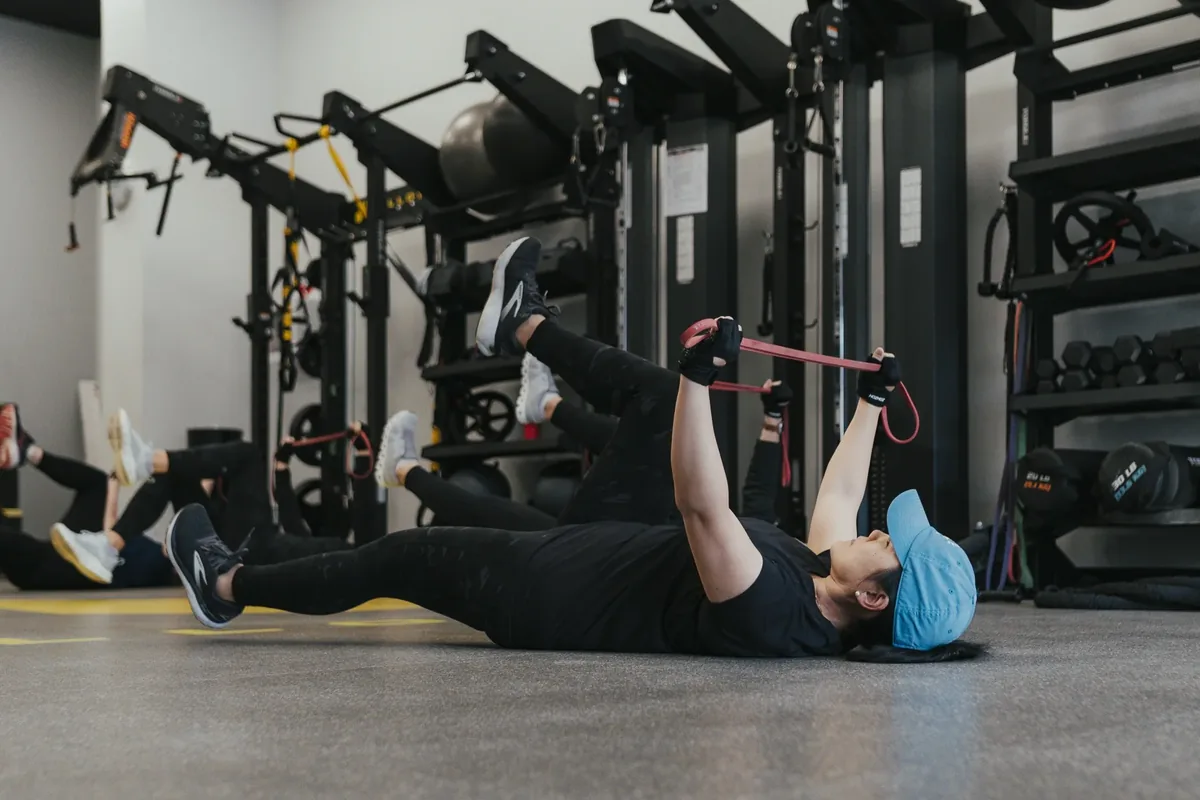
How long should you hold a hip stretch, and how often?
Hold each stretch for 30 to 60 seconds if you're in your 60s or beyond, or 10 to 30 seconds for most adults, repeat it 2 to 4 times, and do it at least 2 to 3 days a week. That's the 2011 American College of Sports Medicine (ACSM) position stand, which also notes greater gains from daily practice. Stretch to the point of slight discomfort, not pain.
One hip-specific study used a bigger dose. In a 2011 trial of 82 healthy older adults, those who stretched their hip flexors twice a day for 10 weeks gained passive hip extension versus a shoulder-stretching group. Those who started with limited hip extension also lengthened their stride.
For the strength moves in the table, the same position stand recommends resistance training 2 to 3 days a week.
Should you do hip mobility work before a workout or on its own?
Both work, with different hold times. A 2016 review of stretching research in healthy, active people found that static holds under 60 seconds per muscle lowered performance by only about 1%. Holds of 60 seconds or longer lowered it by 4.6%, and the authors recommend following any warm-up stretching with dynamic movement.
Before training, keep holds short and follow them with hip CARs, the world's greatest stretch, lateral lunges and bridges. Save the longer 90/90 and hip flexor holds for after training or rest days. The same review found that extra range from a single session typically fades within 30 minutes.
A few minutes of easy walking is a simple start, and the track at Evelyn Greer Park, on the same street as the studio, works well. On a weekend, the flat paths at Matheson Hammock Park do the same job with a water view. In the wet season, from mid-May to mid-October, dew points sit in the 70s most mornings, so you'll warm up fast. Bring water.
When tight hips need a clinician, not a coach
See a physician or physical therapist first if any of these warning signs apply. The UK's National Health Service advises seeing a doctor if:
- hip pain keeps you from normal activities or affects your sleep
- the pain is getting worse or keeps coming back
- it hasn't improved after 2 weeks of home care
- you have hip stiffness for more than 30 minutes after waking up
The same page advises urgent care for sudden, severe hip pain without an injury, a hip that is swollen and feels hot, a change in skin color, or hip pain with a fever. Severe pain after a fall, being unable to put weight on the leg, or tingling or numbness after an injury calls for emergency care.
Check with your physician or PT first, too, after a hip replacement or other hip surgery, or if you notice groin pain, a hip that locks, or pain that changes how you walk. We're glad to coordinate with your clinician and work within their guidance. Our guide to seeing a physical therapist vs a personal trainer explains who does what.
See where your hips stand
A coach watching you squat, lunge and step can usually spot where your hips are restricted. That's where the free Personal Fitness Assessment starts: a no-pressure session covering how you move, your health history and goals, your fitness baseline and your first InBody scan. You leave with a personalized roadmap, with movement prep and corrective work for your hips built into the plan. Book your free Personal Fitness Assessment.
Opening October 2026 at 8285 SW 124th Street. Our first 75 founding members get first pick of session times, priority onboarding, and our Founder's Rate. See founding membership.
This article is general fitness information, not medical advice. Talk with your physician before starting a new exercise program, especially if you have a diagnosis, a recent injury or surgery, or activity restrictions.