
Strength training over 40 starts with two full-body sessions a week, using weights you can lift with good form for 8 to 12 controlled reps and adding a little load every week or two. That matches federal guidelines, which call for muscle-strengthening work on 2 or more days a week. A 2019 position stand from the National Strength and Conditioning Association (NSCA) recommends 2 to 3 sessions a week of 2 to 3 sets per muscle group for adults over 50. In pooled trials of adults aged 50 to 92, average strength gains ran 24 to 33 percent depending on the lift, and age did not predict the size of the gain.
- After 40, strength and power fade faster than muscle size, and most muscle loss is in the lower body.
- It isn't too late: in trials of adults aged 50 to 92, age didn't predict strength gains.
- Start with two full-body sessions a week at light loads, and add 2 to 10 percent once you beat your rep target twice in a row.
- Self-chosen weights tend to be too light to build strength, so have someone set and track your loads.
- Soreness from new exercise usually peaks at 48 to 72 hours; sharp joint pain or swelling is a reason to call your physician.
What actually changes in your body after 40
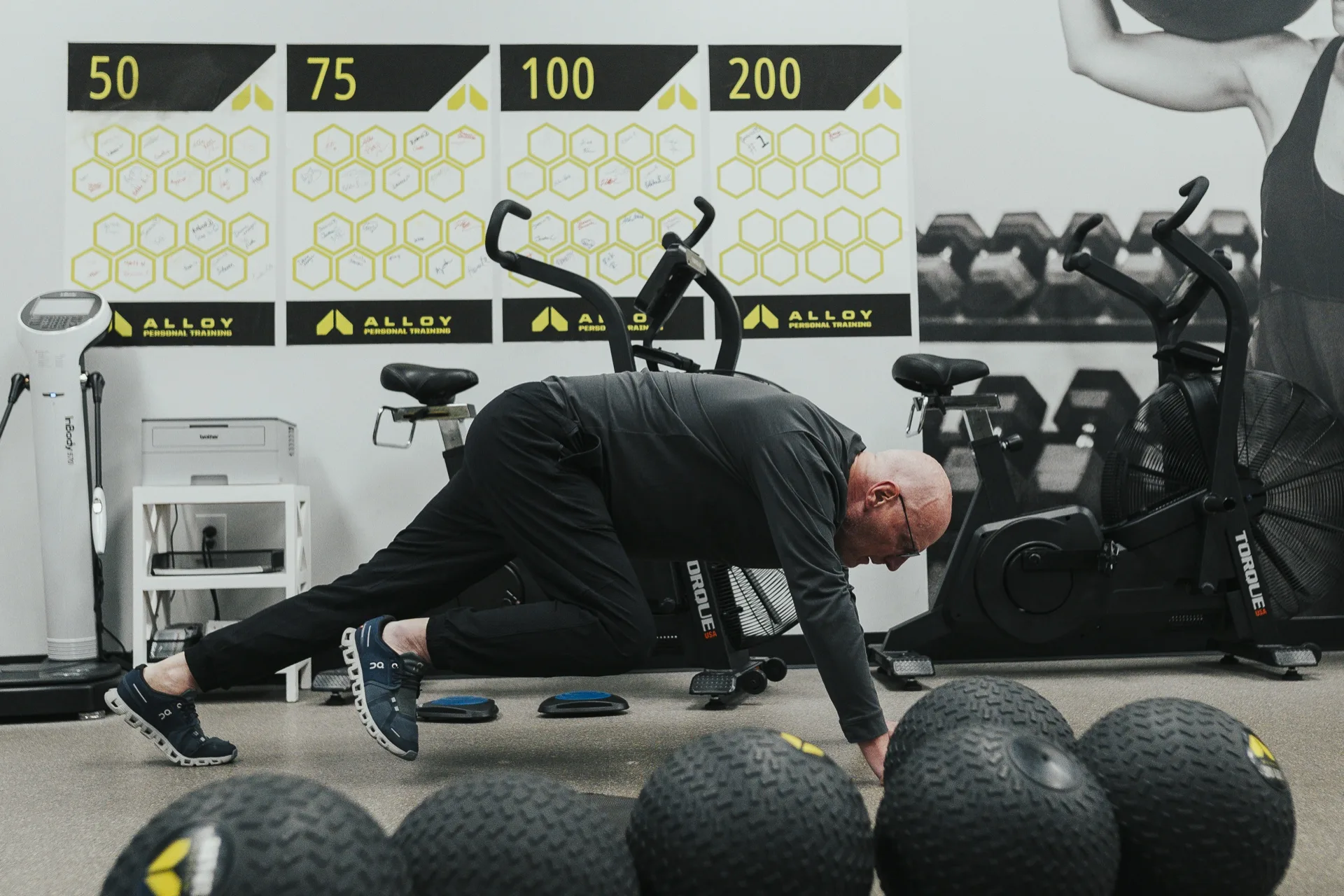
Muscle doesn't fall off a cliff on your 40th birthday. The changes are gradual, and they hit strength, power and the lower body hardest.
An MRI study of 468 adults aged 18 to 88 found that a noticeable drop in muscle mass did not appear until the late 40s, and most of that loss was in the lower body. That's one reason to prioritize squats, hinges, lunges and step-ups over the muscles you see in the mirror.
Strength fades faster than muscle. The NSCA's 2019 position stand on resistance training for adults over 50 notes that declines in strength run two to five times greater than declines in muscle size. Train strength directly, not just size.
Power slips even sooner. Researchers at Tufts reported in 2012 that muscle power, the ability to move a load quickly, declines earlier and more steeply with age than strength does. That's why the table below ends with lighter, faster lifting.
These figures are population averages. They describe what tends to happen when nothing changes, not a timeline your body has to follow. They're also close to home: Census Bureau estimates put Pinecrest's median age just over 42, and by the same Census figures, roughly three in four adults in the Village are 40 or older.
Is 40 too late to start strength training?
No. Trials of resistance training in adults from their 50s into their 90s still found clear strength gains.
A 2010 meta-analysis of 47 studies pooled 1,079 participants aged 50 to 92. Average gains ranged from 24 percent on the chest press to 33 percent on knee extension. Neither age nor sex was linked to how much strength people gained.
Muscle responds too, and starting sooner may help. A 2011 meta-analysis of 49 studies in 1,328 adults aged 50 and older found an average gain of about 1.1 kg (roughly 2.4 pounds) of lean mass. Older participants gained less, and the authors suggested that starting earlier may bring better results.
For a closer match to a beginner in their 40s, a 12-week trial of 74 sedentary adults aged 40 to 65 found that about an hour a week of resistance training, done alongside cardio, improved knee strength by 11 to 16 percent. The control group showed no significant change. Because the program combined strength and endurance work, it isn't a pure lifting result.
The NSCA concludes that a properly designed program, with instruction in exercise technique and proper spotting, is "safe for healthy, older adults."
As for results, most people notice improvements in energy, strength and confidence within the first few weeks, while changes in body composition typically show over 8 to 12 weeks.
How many days a week should you strength train after 40?
Two to three days, with two as the floor. The Physical Activity Guidelines for Americans call for muscle-strengthening work of moderate or greater intensity, covering all major muscle groups, on 2 or more days a week. For beginners, the 2009 position stand on resistance training progression from the American College of Sports Medicine (ACSM) lands on the same 2 to 3 days as the NSCA.
The guidelines also tell inactive people to start low and go slow. In practice, that means two full-body sessions a week to begin, adding a third once you're recovering well. In our strength training program for adults 40 and over, two coached 55-minute sessions a week cover the federal muscle-strengthening minimum on their own.
The same guidelines ask for 150 to 300 minutes a week of moderate aerobic activity. Evelyn Greer Park, next door to the studio on SW 124th Street, has a walking and jogging track for that, the shaded Old Cutler Trail works for longer walks or an easy ride, and a pickleball hour at Dante Fascell Park counts too. Just plan around the weather: NOAA's climate normals put Miami-Dade's August afternoon heat index near 97°F, and the National Weather Service dates the rainy season May 15 to October 15. A fixed indoor slot for strength work is easier to keep through all of it.
The starting dose for strength training over 40
Start lighter than you think, then progress by a rule instead of a feeling. ACSM's progression stand defines a novice as someone with no resistance-training experience or who hasn't trained for several years, which describes most people starting out or coming back. Its advice is to learn the lifts at 50 to 60 percent of your one-rep max or less, because form and technique come first, then train at 60 to 70 percent for 8 to 12 reps.
Your one-rep max is the heaviest weight you could lift once with good form. You don't need to test it; a coach can estimate it from lighter sets. Here's a sensible way to lay that out:
| Phase | Load | Sets per exercise | Sessions a week |
|---|---|---|---|
| Learning the lifts (about weeks 1 to 2) | 50 to 60% of your one-rep max, or lighter | 1 to 2 | 2 |
| Building (about weeks 3 to 8) | 60 to 70% of your one-rep max | 2 to 3 | 2 to 3 |
| Later, once technique is solid | Working toward 70 to 85%, plus power moves at 40 to 60% lifted quickly | 2 to 3 | 2 to 3 |
ACSM's own novice range is 1 to 3 sets and 2 to 3 days a week; the table starts at the low end of both. Reps stay at 8 to 12 through the first two phases. Rest 1 to 2 minutes between sets of assistance exercises and 2 to 3 minutes on the main lifts. Then follow ACSM's progression rule: when you can do one or two reps beyond your target in two consecutive sessions, add 2 to 10 percent to the load.
The last row comes from the NSCA, which recommends working toward 70 to 85 percent of max and adding power exercises at 40 to 60 percent, moved quickly through the lifting phase.
Why guessing your own weights rarely works
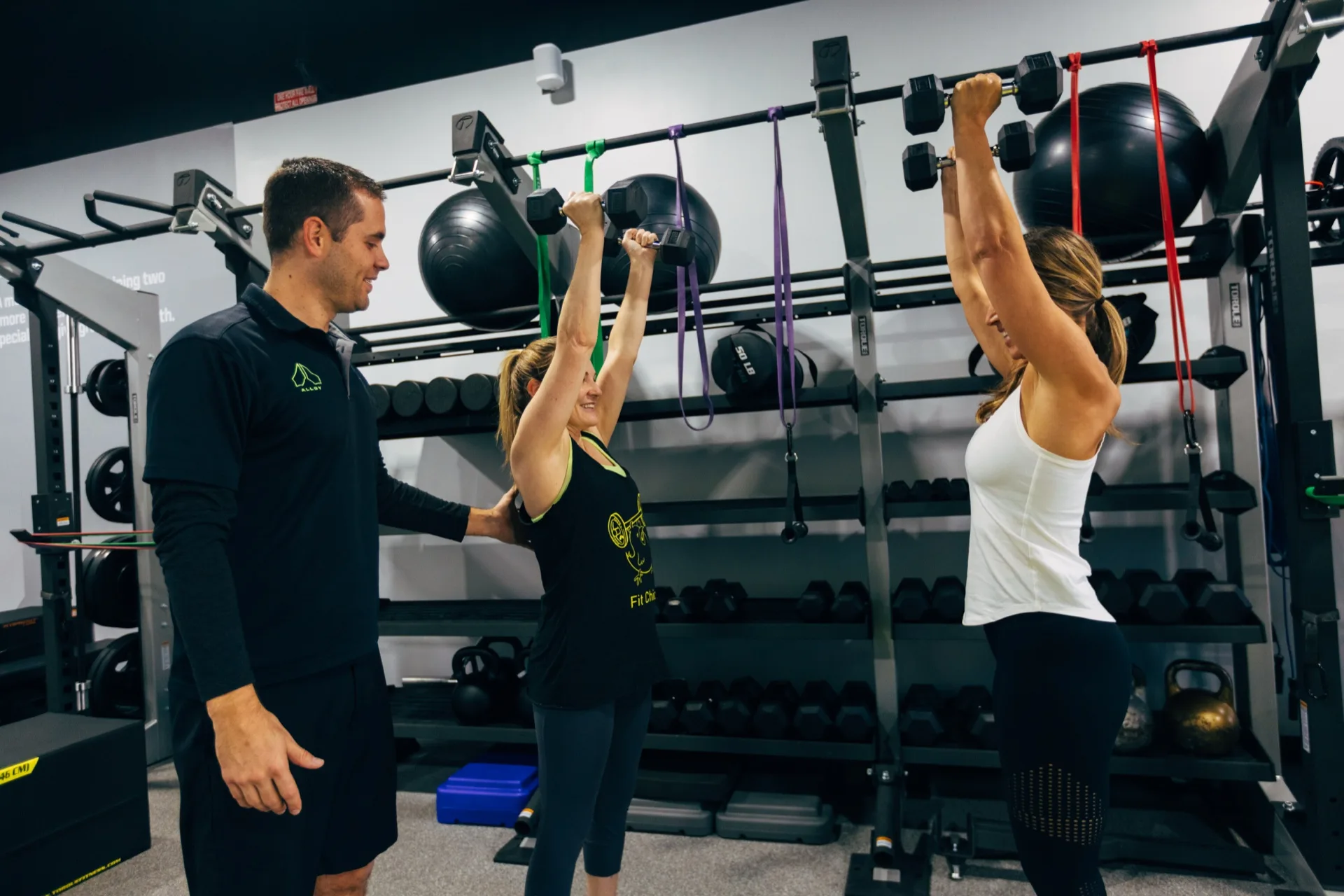
People new to lifting tend to choose weights too light to build strength. In a 2004 study of 30 untrained college-age adults, everyone asked to pick a load that would improve their strength chose less than 60 percent of their max, in a range of 42 to 57 percent. The authors judged those loads too light to drive strength gains and advised that a trainer test the client's strength and teach the load required.
ACSM's position stand makes the same point about self-selected loads, citing 38 to 58 percent of max. Load matters: in the 2010 meta-analysis above, higher-intensity programs were linked to larger strength gains.
Going too heavy too soon is the opposite error. The NSCA notes that injuries occur "mainly in those non-experienced subjects," tied to heavy, repetitive workloads, unfavorable positioning or incorrect technique, and exercise selection.
This is the practical case for coaching. In small group personal training, a coach sets your starting loads, watches your technique, and raises the weight when the progression rule says you're ready. Alloy's model caps each session at six clients per coach, so that attention isn't spread thin.
Soreness, recovery and what's normal in month one
Some soreness is normal, and it shows up after the workout, not during it. A 2024 sports-medicine review describes soreness after unaccustomed exercise starting 6 to 12 hours later, peaking at 48 to 72 hours, and usually clearing within a week. The authors describe it as usually harmless.
Early progress can mislead in both directions. ACSM notes that strength may increase significantly within the first week of training, a gain it links to neural adaptation: your nervous system getting better at the movement. So don't judge week one by how sore or how strong you feel.
Some pain isn't ordinary soreness. Sharp joint pain, swelling, or pain that changes how you walk is a reason to stop and talk with your physician or physical therapist. If you're working around an old injury or chronic tightness, we're glad to coordinate with your physician or PT, and our functional mobility and joint health work builds movement prep and corrective exercises into each plan.
How to start strength training after 40: your first month
Here's how those numbers translate into a first month you can actually finish:
- Week 1: Get a baseline of how you move and where your strength stands (here's what a fitness assessment covers). Then do two full-body sessions at learning loads, 1 to 2 sets per exercise.
- Week 2: Two sessions, 2 sets of 8 to 12 reps. Same exercises, cleaner form.
- Week 3: Two or three sessions, 2 to 3 sets each. Make your first 2 to 10 percent load increases on any lift where you've beaten the rep target two sessions running.
- Week 4: Same structure, then a 30-day check-in to review progress and adjust loads and goals. In our program, that's a monthly accountability session with an updated InBody body composition scan.
Log every session: exercise, load, sets and reps. The progression rule only works if you can see last week's numbers, and a written log turns "I think I'm stronger" into something you can check.
Find your real starting weights
This guide can't tell you your actual starting loads or how your plan should change month to month. A free Personal Fitness Assessment covers both: a coach looks at how you move, talks through your health history and goals, measures your current baseline, runs your first InBody scan, and maps out a personalized roadmap. It's a no-pressure first step, and you can book your free Personal Fitness Assessment whenever you're ready.
Opening October 2026 at 8285 SW 124th Street. Our first 75 founding members get first pick of session times, priority onboarding, and our Founder's Rate. See founding membership.
This article is general fitness information, not medical advice. Talk with your physician before starting a new exercise program, especially if you have a diagnosis, a recent injury or surgery, or activity restrictions.