
After an injury, the physical therapist vs personal trainer choice comes down to timing: see a physical therapist first if the injury is new, the pain limits your daily activity, or you're recovering from surgery. Physical therapists are licensed clinicians who examine, diagnose and treat movement problems, and in Florida you can start without a referral; a practitioner of record only has to review the plan if care runs past 30 days. A personal trainer fits once you're cleared or discharged, when the work shifts to rebuilding strength and fitness inside the limits your clinician set.
- A new injury, pain that limits daily life, or a recent surgery means a physical therapist or physician first.
- Physical therapists handle diagnosis and rehab; trainers take over after you're cleared or discharged.
- Florida lets you start physical therapy without a referral; a practitioner of record reviews the plan only if care runs past 30 days, and your insurance plan may still ask for one.
- Back pain with leg numbness or weakness, pain that wakes you at night, or pain below the knee needs a clinician first.
- Bring your discharge summary, restrictions and home exercise program to your first training session.

The short answer: new injury, limiting pain or recent surgery means a physical therapist first
The two professions work in sequence. A physical therapist's job is to find out what's wrong and guide your recovery. A trainer's job starts when that work is done: building the strength and conditioning that keep you doing what you enjoy.
Problems start when someone skips a stage: training through pain nobody has examined, or stopping all exercise the day the last therapy visit ends.
The gray areas are harder: the knee that aches after a long walk around Matheson Hammock, the shoulder that's been cranky for two years, the back that tightens up every few months. Some of those need a clinic and some don't. The scenario table below sorts them out.
Physical therapist vs personal trainer: what a PT can do that a trainer can't
A physical therapist is a licensed clinician. To practice in the U.S., a PT must earn a Doctor of Physical Therapy degree from an accredited program and pass a state licensure exam, according to the American Physical Therapy Association. In the association's words, physical therapists "examine, diagnose, and treat individuals of all ages."
Personal trainers aren't clinicians, and they don't hold a license. The federal Occupational Outlook Handbook says fitness trainers "typically need a high school diploma to enter the occupation," and most hold a certification.
The fitness industry draws the line itself. The American Council on Exercise's personal trainer manual reprints a scope-of-practice table first published by the IDEA Health & Fitness Association in 2001. It says trainers do not "Diagnose," "Treat injury or disease" or "Rehabilitate." What they do is "Design an exercise program once a client has been released from rehabilitation."
| Physical therapist | Personal trainer | |
|---|---|---|
| Training | Doctorate (DPT), typically three years | High school diploma typical; most certified |
| Credential | State license | Certification, no license |
| Diagnoses or rehabilitates injuries | Yes | No; builds programs after release from rehab |
| How it's usually paid | Often billed to insurance | Usually out of pocket |
Do I need a referral for physical therapy in Florida?
No, not to get started. Florida law lets a physical therapist evaluate you and start care without a physician's referral. The main condition is about timing, and Section 486.021 of the 2026 Florida Statutes spells it out: "If physical therapy treatment for a patient is required beyond 30 days for a condition not previously assessed by a practitioner of record, the physical therapist shall have a practitioner of record review and sign the plan."
A practitioner of record here means a physician or another licensed practitioner named in the statute. If your condition falls outside the scope of physical therapy, the law also requires the therapist to refer you to one or consult with one.
Insurance is a separate question. Some plans still want a referral before they'll pay for therapy, so check your plan's rules before you book.
Red flags that belong with a clinician, not a coach
Some symptoms need a clinician before any exercise program, however gentle. MedlinePlus, the National Institutes of Health's consumer health library, says to contact your provider right away if back pain comes with any of these:
- Pain after a severe blow or fall
- Loss of control over urine or stool
- Pain traveling down your legs below the knee
- Pain that wakes you up at night
- Weakness or numbness in your buttocks, thigh, leg or pelvis
- Difficulty walking or maintaining your balance
- Unexplained fever
- Redness or swelling on the back or spine
It also lists a back pain episode lasting longer than 4 weeks as a reason to contact your provider.
For a sprain, it says to go to the hospital for a suspected broken bone, a joint that looks out of position, or a pop followed by immediate trouble using the joint. Call your provider if swelling doesn't start to go away within 2 days or the pain hasn't gone away after several weeks.
If any of these apply, talk with your physician or physical therapist before you start or restart training. A good coach will also send you back to a clinician if one shows up mid-program; the industry's scope standard lists referral as part of the job.
When a personal trainer is the right next step
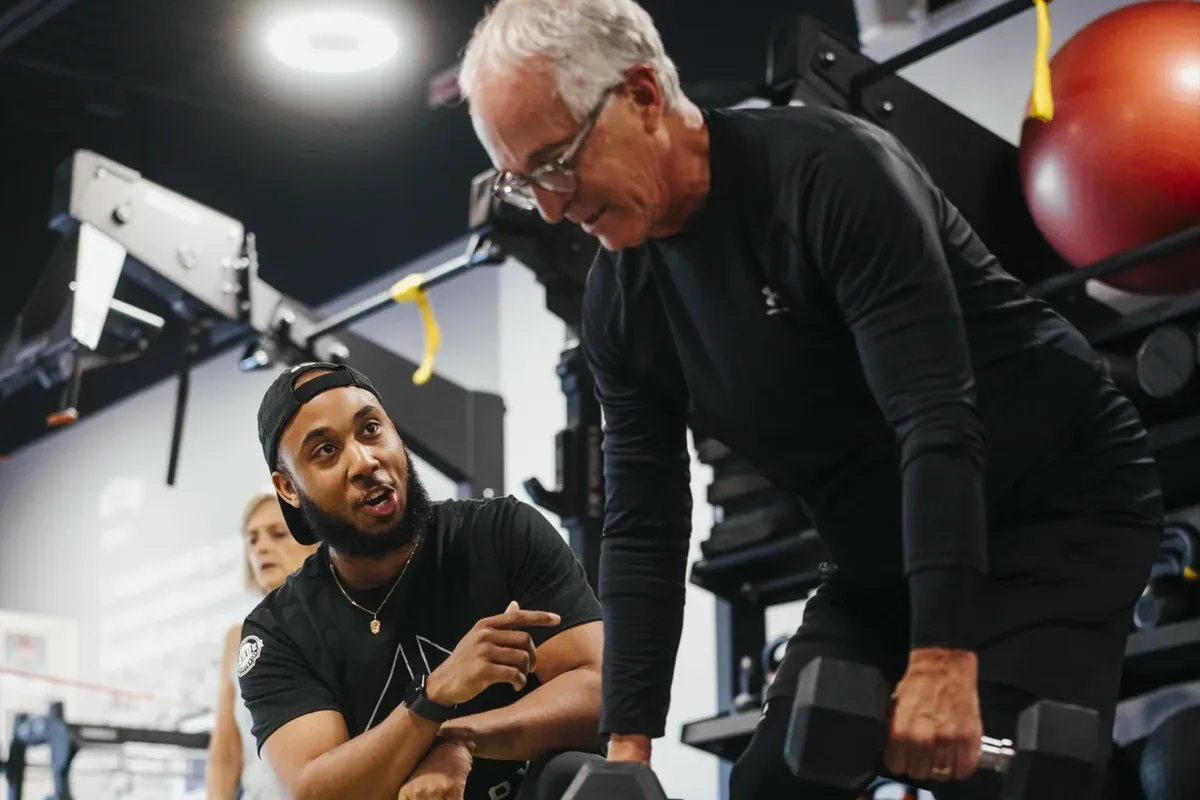
A personal trainer makes sense once a clinician has cleared you, or when the issue is fitness rather than injury. Roughly three in four Pinecrest adults are 40 or older, so these questions come up often here. Here's how common situations sort out:
| Your situation | Who to see first | What that looks like |
|---|---|---|
| New injury, a fall, or pain that limits daily activity | Physician or physical therapist | Examination and diagnosis before any training |
| Recent surgery, still in rehab | Your surgeon and physical therapist | Finish the rehab plan; training waits for clearance |
| Discharged from PT, cleared, restrictions in hand | Personal trainer | A program built inside your written limits |
| Old injury that flares with activity, no red flags, no pain right now | An assessment first | A coach checks how you move and coordinates with your PT if needed |
| Chronic stiffness, no pain | Personal trainer | Strength work with mobility and joint-health work built in |
| Not sure which applies | An assessment | A coach who refers you out if anything looks outside their scope |
Those gray-area rows are why we start everyone with a Personal Fitness Assessment. If something looks outside a coach's scope, the right call is a referral, and we're glad to coordinate with your physician or PT. Our guide to what a fitness assessment tests walks through each step.
For stiffness without pain, functional mobility and joint-health work belongs in the plan from the first session, with targeted movement prep and corrective exercise built in.
Why the weeks after physical therapy matter
Formal rehab can end quickly. A 2011 study in the journal Physical Therapy looked at 1,840 Medicare outpatient physical therapy episodes in one health system. The patients' average age was 74, and episodes averaged 6.8 visits. Lower back, shoulder and knee problems made up 71.3% of them.
Your own plan may look different, especially if you're younger than that group.
The evidence for staying active is encouraging, with caveats, at least for the lower back. A 2016 review in JAMA Internal Medicine pooled 21 randomized trials with 30,850 participants. Exercise was associated with a 35% lower risk of a new low-back pain episode in the short term (low-quality evidence), and exercise plus education with a 45% lower risk (moderate-quality evidence).
Education alone, back belts and shoe insoles showed no effect. The trials weren't limited to people over 40 or to people finishing rehab, so read the result as a reason to keep moving rather than a promise.
Sticking with a program is hard even inside formal care. In a 2022 study in PLOS One of 2,243 patients in exercise-based physical therapy for low back pain at five San Diego clinics, only 43% were adherent. That meant attending at least 16 of 20 prescribed visits over 10 weeks, or being formally discharged.
Age, sex and other health conditions weren't associated with who stuck with it. Among patients who weren't adherent, 31.7% stopped because of "logistic and accessibility issues."
A standing appointment with a coach who is expecting you can take some of that friction away. In a Miami-Dade summer, when heat and humidity make "I'll walk later" easy to skip, a scheduled indoor session tends to be easier to keep.
How a good handoff works: what to bring to your first session
The best handoffs come with paperwork. If you're hiring a personal trainer after physical therapy, bring these to your first session:
- Your discharge summary, or a copy of your therapist's final notes
- Your movement restrictions and load limits: what to avoid and how much weight you're cleared for
- Your home exercise program, so the coach can build on it instead of replacing it
- Written permission for the coach to contact your physical therapist or physician
- The goal your PT set, plus your own, like climbing stairs without the rail
The load limits matter most to a coach, because they set the ceiling for every exercise in the plan. The permission step matters too. The same trainer manual says that when a client is referred by a physician, the trainer should get the client's written permission to communicate with that physician.
In our small group personal training, capped at six clients per coach, the coach can watch your reps and keep the program inside your limits.
If walking is cleared, try an easy lap or two before your first session. The track at Evelyn Greer Park is next door to the studio on SW 124th Street. Note how the knee or back feels, and tell your coach.
Start where rehab ended
Book your free Personal Fitness Assessment and bring any notes from your physical therapist or physician. A coach will look at how you move, go through your health history and restrictions, measure your fitness baseline, run your first InBody scan, and map out a plan that starts where rehab ended. There's no pressure to sign up, and if anything points back to a clinician, we'll say so.
Opening October 2026 at 8285 SW 124th Street. Our first 75 founding members get first pick of session times, priority onboarding, and our Founder's Rate. See founding membership.
This article is general fitness information, not medical advice. Talk with your physician before starting a new exercise program, especially if you have a diagnosis, a recent injury or surgery, or activity restrictions.