
Gyms in Pinecrest, FL come in almost every format: big-box clubs, 24-hour gyms, HIIT, CrossFit-style, reformer Pilates, barre, yoga and EMS studios, one-on-one trainers, the Village's community-center gym, and small group personal training. After 40, the right choice depends less on equipment and more on three things: who sets your training load, how much coaching is in the room, and whether the format can work around an old injury. The first one matters more than most people expect. In a 2004 study of 30 beginners, people picking their own weights chose 42 to 57 percent of their one-rep max, below the range the authors considered enough to build strength.
- After 40, choose a gym by who sets your load, how much coaching you get, and how it handles old injuries.
- Cheap dues only pay off if you keep going, and early dropout is common.
- Left alone, beginners tend to lift too light, and closer coaching produced bigger strength gains in a study of untrained young men.
- The Village's parks and the South Dade Trail make good free extras alongside coached sessions.
- Before signing a Florida health-studio contract, check it for your 3-day cancellation right (weekends and holidays excluded) and other protections.

What kinds of gyms are in Pinecrest, FL?
Nearly every kind. There are dozens of gyms and studios within three miles of US-1 and SW 124th, and at least eight within a half mile. There's no single best gym in Pinecrest, just the best fit for your body and schedule.
Here's how the main types compare. Small group personal training is the format we coach, so weigh that row accordingly.
| Type | Who sets your load | Coaching in the room | Often a good fit for |
|---|---|---|---|
| Big-box club | You | Trainers available, usually at extra cost | Self-directed exercisers who want lots of equipment and class variety |
| 24-hour gym | You | Limited, especially late at night | Experienced lifters with early, late or shift-work schedules |
| HIIT class studio | The class plan; you pick weights and pace | One coach leading the whole room | People who like high energy and cardio-heavy work |
| Boot camp or CrossFit-style gym | The coach programs it; you scale it | Coach-led; group sizes vary | People who enjoy competition, community and varied workouts |
| Reformer Pilates or barre studio | Instructor cues; springs, light weights or body weight | Instructor-led class | Controlled, lower-impact work and core control |
| Yoga studio | Your body weight | Teacher-led class | Mobility, balance and a calmer hour |
| EMS studio | The coach sets the stimulation level | Coach-led, short sessions | Busy people who want a compact, supervised workout |
| One-on-one training studio | Your trainer | Full attention on one client | Complex goals, specific injuries or anyone who wants privacy |
| The Village's community-center gym | You, unless you book a trainer | Personal trainers and group classes available | Anyone who wants a public gym with a stretch zone and locker rooms |
| Small group personal training | Your coach, person by person | One coach, up to six people in ours | People who want an individualized plan at a lower per-session cost than one-on-one |
Two patterns stand out. The more a format relies on you choosing the weight, the more it rewards experience. The more coaching per person, the easier it is to train around a stiff shoulder or a cranky knee. Every format has trade-offs, ours included: small group sessions run on a set schedule and won't feel like a loud, packed class.
Is a cheap gym membership worth it after 40?
It can be, as long as you keep going. The Health & Fitness Association's October 2024 report found average U.S. monthly dues rose 9 percent in 2023 to $65, and nearly 67 percent of members paid under $50 a month. That 2023 figure is the most recent public average.
Gym membership cost in Pinecrest runs from the Village's community-center gym, which sells low-cost day passes and monthly plans, to boutique studios along US-1 that typically publish tiered monthly plans. Most places offer a free first class, session or trial week.
The real cost depends on attendance. In a 2016 study of 5,240 new members at a single fitness center in Brazil, 63 percent had quit before month three, and under 4 percent were still training continuously at 12 months. Divide any monthly price by the sessions you actually complete, then compare that number.
For coaching prices, our breakdown of personal trainer costs in Miami compares one-on-one and small group market ranges.
Why "just going to the gym" often falls short
Mostly because beginners on their own tend to choose loads too light to build strength. Picking a weight is a skill, and new lifters often guess low.
A target set for you changes that without turning every session into a grind. In a 2024 trial of 24 adults in their mid-60s, one group got a target (three sets of 10) and chose the weight that fit it, while the other lifted prescribed loads. Over 12 weeks, both groups showed similar improvements in strength and functional capacity, and the self-selecting group reported lower effort and more positive feelings in weeks 8 to 12.
Supervision ratio matters too. In an 11-week study of 124 untrained young men on identical programs, the group trained at one coach per five people raised their one-rep bench press by about 16 percent, versus about 10 percent at one coach per 25. Attendance didn't differ between the groups, and more of the closely coached group trained at maximal intensity.
That's the idea behind small group personal training: the coach sets each person's load, and the group stays small enough for the coach to see everyone. Whichever gym you choose, ask who decides what you lift next week.
Intensity, injuries and the body you have now
The evidence doesn't single out high-intensity formats as uniquely risky, and it is specific about what raises the odds of getting hurt.
A 2022 systematic review of 25 studies covering 12,079 CrossFit-style practitioners found injury incidence similar to weightlifting and powerlifting. The shoulder (26 percent), spine (24 percent) and knee (18 percent) were the most frequently injured sites. The risk factors the authors listed included older age, previous injuries and insufficient coaching.
Two of those, age and injury history, come with you into any gym. Coaching is the one you get to choose.
If you're carrying an old injury, talk with your physician or physical therapist before you start, and get any sharp, worsening or unexplained pain checked by a clinician. A good coach works within that guidance, and we're glad to coordinate with your physician or PT. Movement prep and corrective exercise should start in the first session, which is why we build functional mobility and joint health work into every plan.
Does training in a group help you stick with it?
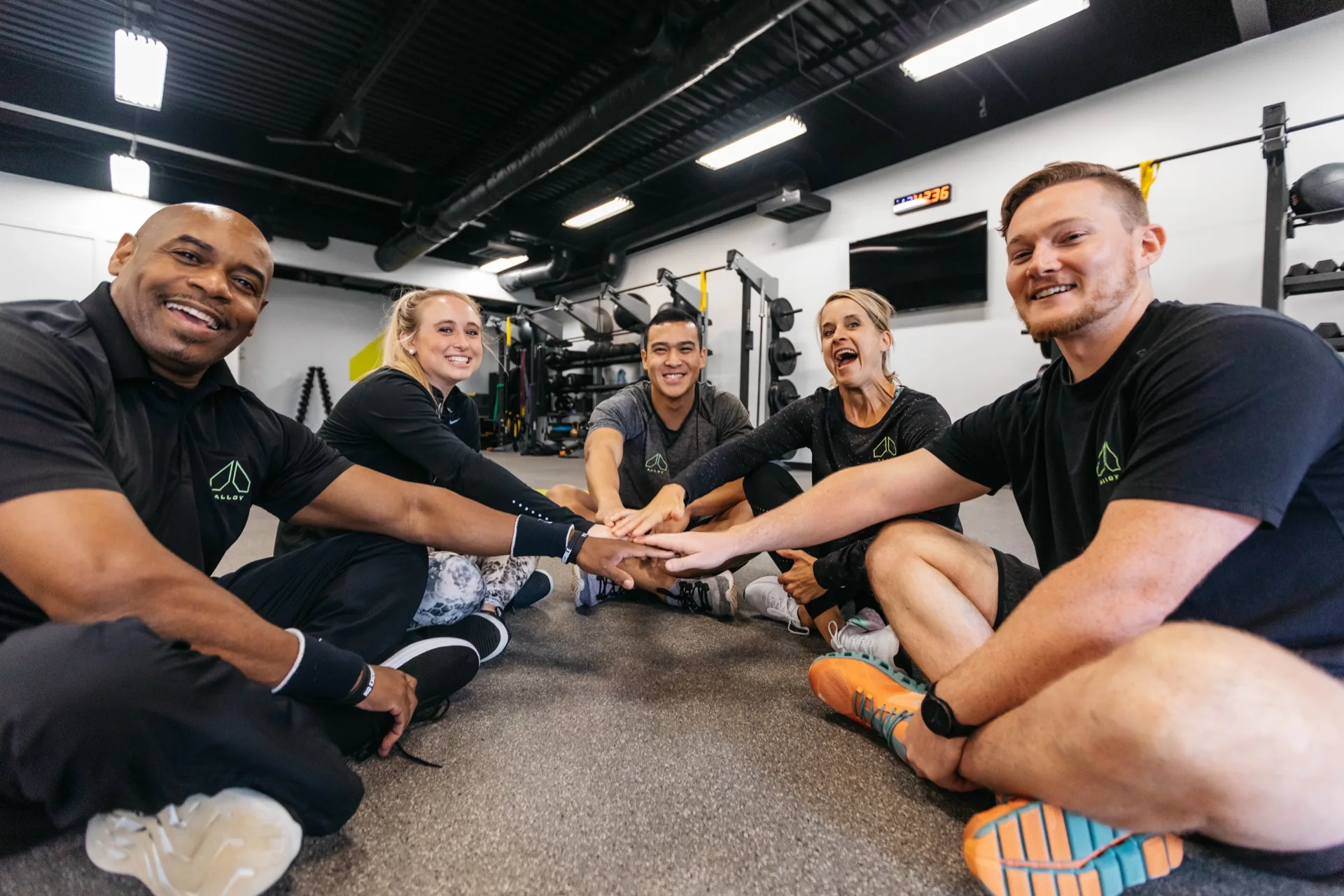
It does, particularly when the group is small and people know each other. A 2006 meta-analysis of 44 studies found that exercising in a "true group," one that uses group-dynamics principles to build cohesion, beat a standard exercise class on outcomes including adherence. The standard class, in turn, did not differ from "exercising at home with contact."
On a tour, notice the difference between a big class with a rotating crowd and a small group where the coach knows every client by name.
If you've been searching "small group training near me," our guide to small group personal training explains how the format works.
Free options worth using: parks, trails and courts nearby
The Village's free options are good ones. Evelyn Greer Park, just down SW 124th Street from our studio, has outdoor gym equipment, exercise stations, a walking and jogging track, and paved walking trails.
Suniland Park, on Pinecrest Parkway, also has outdoor gym equipment and paved walking trails. The South Dade Trail runs beside US-1 through Pinecrest; Miami-Dade County puts its full length at approximately 22 miles. The shaded Old Cutler Trail is the prettier long walk, running under the banyans toward Matheson Hammock Park on the bay. Dante Fascell Park has dedicated pickleball courts, and golfers have the historic Palmetto Golf Course a few minutes south.
Supervision is the reason to pair them with coached sessions. For adults 65 and older, a 2017 meta-analysis of 11 trials found supervised balance and resistance training produced larger strength and balance gains than unsupervised programs, and the authors suggested two of every three weekly sessions be supervised. The park or trail makes a good third session.
Miami-Dade heat and humidity are the other reason: a scheduled indoor session is easier to keep than a midday walk in August. Save outdoor work for early mornings, bring water, and talk with your physician if heat bothers you.
Questions to ask on any gym tour
Ask the same questions everywhere, ideally at the hour you'd actually train.
- Who coaches, and what are their credentials? Ask whether each coach's certification is NCCA-accredited.
- How many people does each coach work with at once? The ratio shapes how much attention you get.
- Who sets my load, and how does it progress? Listen for a plan, not "whatever feels right."
- How do you handle an old injury? A good answer starts with a movement check and your health history; ours is the Personal Fitness Assessment.
- Can I try it first? If there's a free trial, take it before you sign anything.
- Is the studio registered with the state? Florida health studios must register with the Department of Agriculture and Consumer Services; call 1-800-HELP-FLA (435-7352) to check.
Then check your contract. Florida's Health Studio Act, Fla. Stat. 501.017, gives buyers the right to cancel penalty-free "within 3 days, exclusive of holidays and weekends." The statute also allows cancellation if the studio "moves its facilities more than 5 driving miles" without an equal alternate facility within 30 days, and on the buyer's death or physical inability to use "a substantial portion" of the services.
An initial contract can't run "in excess of 36 months," and renewals after that are annual. The law also requires these rights to appear near the signature line "in at least 10-point boldfaced type." This is general information, not legal advice; read your own agreement before you sign.
Know what your body needs before you choose
Every Alloy member starts with a free Personal Fitness Assessment, and it's useful even while you're still comparing gyms. In one no-pressure session, a coach looks at how you move, talks through your health history and goals, measures your fitness baseline, runs your first InBody body composition scan, and maps out a personalized roadmap. You'll leave with a clearer picture of what to look for in any gym. Book your free Personal Fitness Assessment.
Opening October 2026 at 8285 SW 124th Street. Our first 75 founding members get first pick of session times, priority onboarding, and our Founder's Rate. See founding membership.
This article is general fitness information, not medical advice. Talk with your physician before starting a new exercise program, especially if you have a diagnosis, a recent injury or surgery, or activity restrictions.