
Learning how to stay consistent with working out after 40 is mostly about structure, not willpower: a fixed time and place for every session, someone who expects you to show up, and progress measured on a schedule. A long-cited 1994 review in the journal Sports Medicine estimated that about half of people who start an aerobic exercise program stop within the first six months. Scheduled, coached sessions with a progress review every 30 days are designed to close that gap.
- Dropping out early is the norm: in a study of 5,240 gym members, 63% stopped before their third month.
- A gym habit typically takes months. In the best-known study of everyday habits, the median time to automatic was 66 days, with a range of 18 to 254.
- Write if-then plans for your likely obstacles, and keep the same time slot every week.
- The best-supported accountability pairs tracking with feedback and a review of your goals.
- After a miss, come back on your usual day and don't try to make up the missed work.
Why workout routines fall apart after 40
Most routines fall apart early. In a study of 5,240 members of a Brazilian gym, 63% had stopped before their third month, and fewer than 4% kept going for more than 12 months without a break.
Paying for a membership doesn't mean you'll use it. A 2006 study in the American Economic Review of 7,752 gym members found that people on monthly contracts went about 4.3 times a month, far less than they expected when they signed.
The deeper problem is the gap between intending to train and actually training. A 2013 meta-analysis of 3,899 adults found that 36% of people who intended to exercise didn't follow through, an intention-to-action gap the authors put at 46%.
After 40, interruptions stack up: work travel, family schedules, an old injury to work around. A lot of advice on how to stay consistent with exercise comes down to "stay motivated." The better-supported fixes change your setup instead.
How long does it take to make working out a habit?
Plan on months, not weeks. The popular 21-day figure traces back to a 1960s anecdote, not a habit study.
In a widely cited 2010 study, 96 volunteers repeated one daily behavior in the same setting for 12 weeks. The median time for the new behavior to become automatic was 66 days, and individual times ranged from 18 to 254 days.
Gym habits appear to take longer than simpler ones. A 2023 analysis of more than 12 million gym-attendance observations concluded that it typically takes months to form the habit of going to the gym, compared with weeks for handwashing.
Frequency matters too. A 12-week study of 111 new gym members found that at least four exercise bouts a week for six weeks was the minimum needed to establish an exercise habit. Those bouts could be any exercise, so it isn't a prescription for four hard gym sessions a week. In that study, consistency, low complexity, the environment and enjoyment all predicted habit growth.
You don't have to wait for automatic to feel a difference. Most people notice improvements in energy, strength and confidence within the first few weeks, while body composition typically changes over 8 to 12 weeks.
Fix the time and place before you fix the workout
Decide exactly when and where you'll train, and what you'll do if something gets in the way. Psychologists call these if-then plans: "If it's Tuesday after work, I drive straight to the studio." A 2006 meta-analysis by Peter Gollwitzer and Paschal Sheeran, covering 94 independent tests, found these plans had a medium-to-large effect on reaching goals. For exercise specifically, a 2013 review found a smaller effect that still held at follow-up.
Keeping the same time slot seems to help, too. In a study of 375 adults who had maintained long-term weight loss, all active at least two days a week, 68% exercised at a consistent time of day. They logged more days (4.8 versus 4.4 a week) and more minutes (a median of 350 versus 285 a week).
Among those consistent exercisers, the time of day itself made no difference. It was a snapshot of one specific group, so it shows a pattern and nothing stronger.
Four if-then plans built around a Pinecrest schedule:
| If this happens | Then do this |
|---|---|
| Afternoon storms keep canceling your outdoor workout | Move strength work to a standing early-morning slot indoors |
| School pickup lands on your usual workout time | Book an after-work slot on the same two days every week |
| A work trip or family travel takes out a week | Book your first session back before you leave |
| A heat advisory is posted | Keep your indoor session and save outdoor walks for a cooler day |
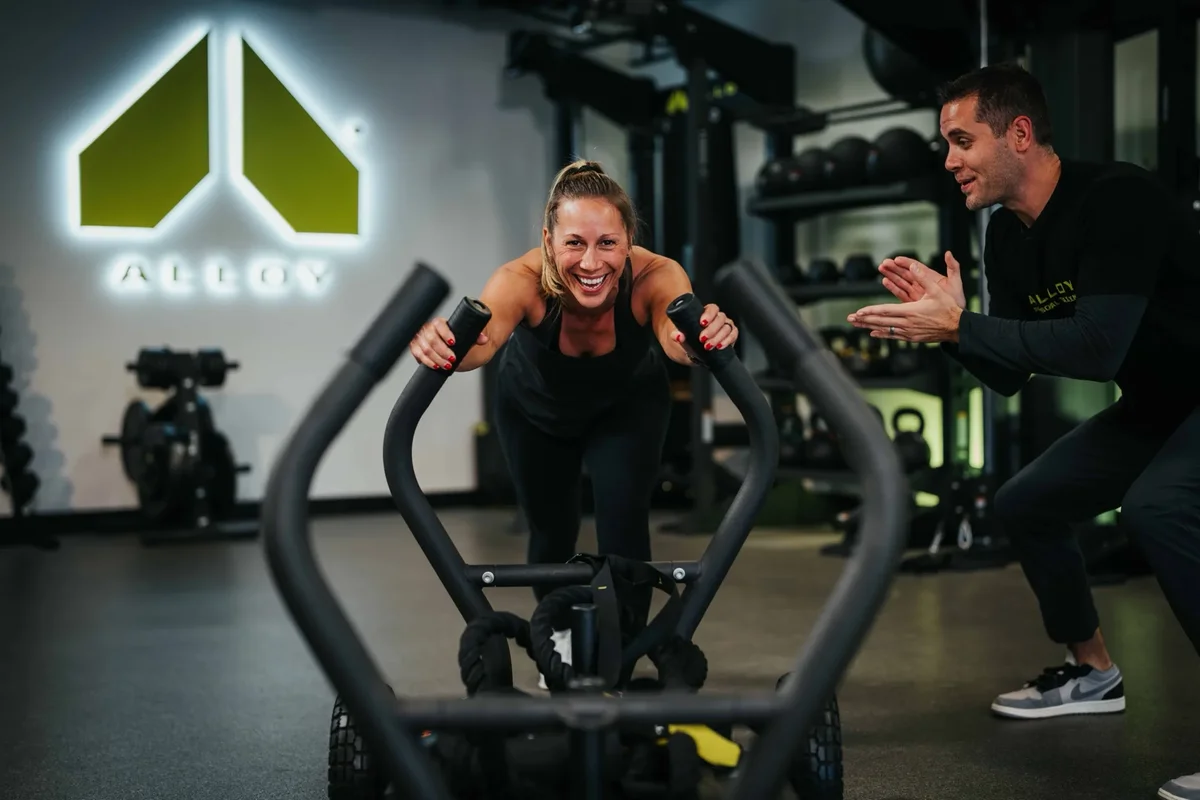
Coached sessions settle the where and most of the when. In small group personal training, sessions run at set times and a coach leads each one, so your job is choosing the slots you'll protect and keeping them like any other appointment.
Workout accountability that works: a coach, a real group and a 30-day review
Workout accountability with the strongest evidence has three parts: tracking what you do, getting feedback on it, and reviewing your goals on a schedule. A 2009 meta-regression of 122 evaluations of physical activity and healthy-eating programs, covering 44,747 adults, found that self-monitoring explained more of the difference in results than any other technique. Programs that combined it with at least one related technique were significantly more effective than the rest, with an effect size of 0.42 versus 0.26. Those related techniques included goal setting, feedback on performance and a review of goals.
That study didn't test a monthly check-in format, and we won't claim it did. But its ingredients line up with how our monthly accountability sessions work: progress tracked over time, a review of that progress with your coach, an updated InBody body composition scan and refined goals every 30 days.
The group matters too, but only if it's a real group. A 2006 meta-analysis of 44 studies found that exercising in a "true group," one deliberately built for cohesion, beat a standard exercise class. The standard class did no better than exercising at home with regular staff contact.
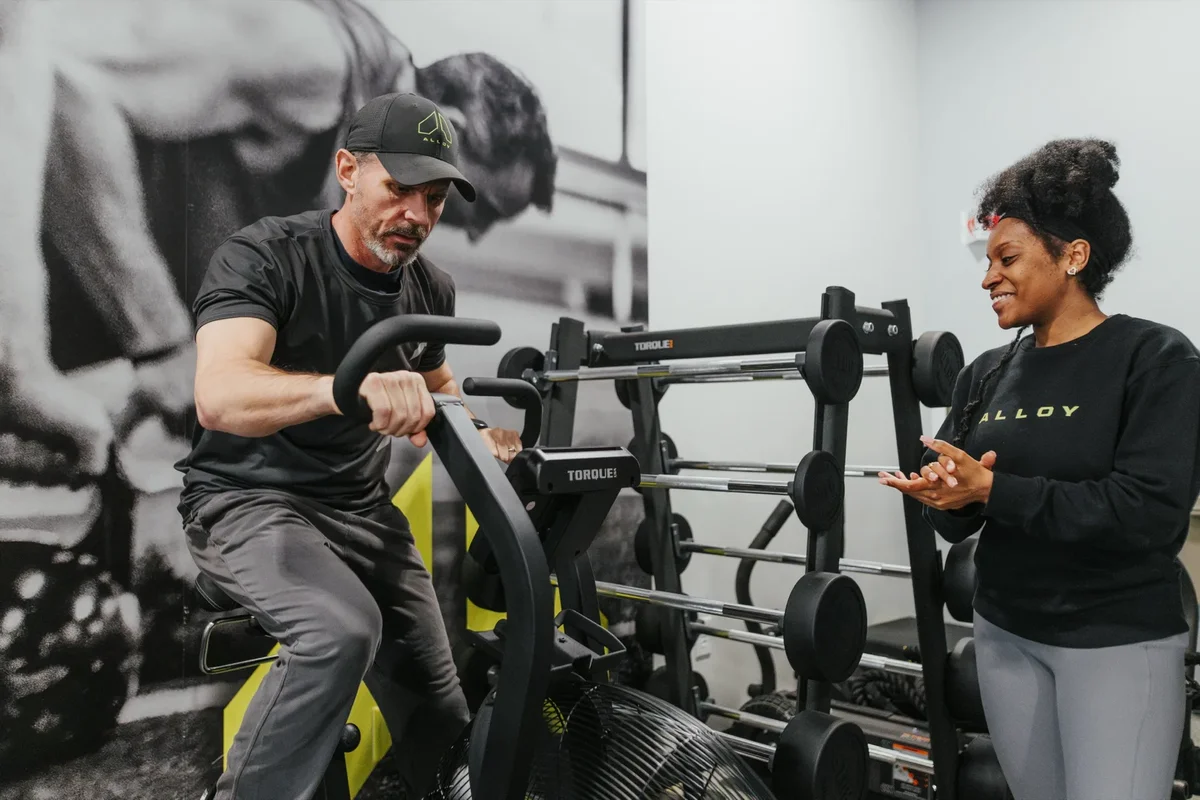
Alloy's model caps each session at six clients per coach, and coaches know every client by name. That setup is built to supply the contact and familiarity this research points to.
South Florida's calendar is the hidden consistency problem
Miami-Dade weather adds a problem most consistency advice ignores. The National Weather Service in Miami dates the wet season from May 15 to October 15. That stretch brings 60 to 70% of the average year's rain, with dew points in the 70s almost daily.
Miami-Dade County's Heat Season, declared in 2022, runs from May 1 through October 31. Hurricane season overlaps it: the National Hurricane Center puts it at June 1 to November 30, with the peak on September 10.
That's half the year an outdoor-only routine has to work around the forecast. A 55-minute indoor session on a fixed schedule doesn't depend on the radar. If heat is a concern for you, talk with your physician before exercising outdoors in the summer months.
Outdoor exercise still has a place. Evelyn Greer Park, next door to the studio, has a walking and jogging track and vita course exercise stations, and the drier months are the time for a morning on the Old Cutler Trail, a shaded walk at Matheson Hammock Park, pickleball at Dante Fascell Park, or a round at Palmetto Golf Course. Use them as extras rather than the whole plan; the indoor strength work is what keeps you ready for all of them. If you're weighing indoor options, our guide to choosing the right kind of gym in Pinecrest compares them.
What to do the week you miss
You'll miss sessions. Some weeks belong to family: a houseful of visitors, a celebration, long dinners along US-1. Training fits around those weeks; it does not compete with them. What you do next matters more than the miss. In the 2010 habit study, missing a single opportunity to perform the behavior didn't materially affect habit formation.
A 2021 megastudy points the same way. It tested 54 four-week programs on 61,293 members of a national gym chain, average age 39. The most effective was a small reward for returning after a missed workout, which raised weekly visits by 27% compared with a placebo condition. Only 8% of the programs still showed a measurable effect after the four weeks ended.
That's an argument for a standing appointment over a clever incentive. A simple return plan:
- Tell your coach what's coming. A trip or a packed work month means the plan changes for a few weeks. It doesn't end.
- Come back on your usual day. Don't wait for a fresh start next month.
- Count the comeback session as the win. Returning after a miss is the behavior the megastudy rewarded.
- Skip the make-up work. Rejoin the plan where it stands, and let your coach set the load that week.
How to stay consistent with working out: your first 30 days
The target is the CDC guideline for adults: 150 minutes of moderate aerobic activity a week plus at least two days of muscle-strengthening activity. Most adults in their 40s, 50s and early 60s don't meet both parts. In the 2020 National Health Interview Survey, 29.4% of men and 22.7% of women aged 35 to 49 met both guidelines. Among adults 50 to 64, it was 21.6% of men and 17.6% of women.
A first month that builds toward it:
- Week 1: Set your baseline and your schedule. Find out how you move and where your strength stands (here's what a fitness assessment covers). Pick two session times you can keep every week, and write one if-then plan for your most likely obstacle.
- Week 2: Two strength sessions and one walk. Two coached strength sessions a week cover the guideline's two strength days. Add one walk on your own. For loads and progression, see our guide to starting strength training after 40.
- Week 3: Hold steady. Same days, same times, same walk. Add a third session only once the first two feel routine, and log every session you do.
- Week 4: Review at day 30. Compare the sessions you planned with the ones you did, note what got in the way, update your if-then plan, and set one goal for the next 30 days. In our program, that's what the monthly accountability session is for.
Start with a plan you can keep
A plan you'll keep starts with an honest look at where you are. The free Personal Fitness Assessment is a no-pressure first session: a coach looks at how you move, talks through your health history and goals, measures your current fitness baseline, runs your first InBody body composition scan, and maps out a personalized roadmap. If you join, your next measured check-in comes 30 days later at your first accountability session. Book your free Personal Fitness Assessment whenever you're ready.
Opening October 2026 at 8285 SW 124th Street. Our first 75 founding members get first pick of session times, priority onboarding, and our Founder's Rate. See founding membership.
This article is general fitness information, not medical advice. Talk with your physician before starting a new exercise program, especially if you have a diagnosis, a recent injury or surgery, or activity restrictions.